

Is AI Making the Internet Feel Less Real?

Are we heading toward a version of the internet where people start tuning out because they do not trust what they are seeing anymore?
AI is not automatically making the internet worse, but it is forcing all of us to think differently about trust, authenticity, and attention. For real estate professionals, the opportunity is not to avoid AI, but to use it in a way that still feels human, local, and relationship-driven.
The Internet Is Starting To Feel Different
I’m genuinely curious what you think about this.
Are we heading toward a version of the internet where people start tuning out because they do not trust what they are seeing anymore?
Because I think that is a real conversation we need to be having.
We are now living in a world where content can be created instantly. Captions, blogs, comments, videos, images, avatars, replies, reviews, emails, and even automated online actions can all be produced or assisted by AI.
And with agentic AI becoming more capable, we are not just talking about tools that answer questions anymore. We are talking about systems that can complete multi-step tasks, interact with websites, generate content, schedule posts, draft replies, and potentially engage online on someone’s behalf.
That brings up a pretty big question:
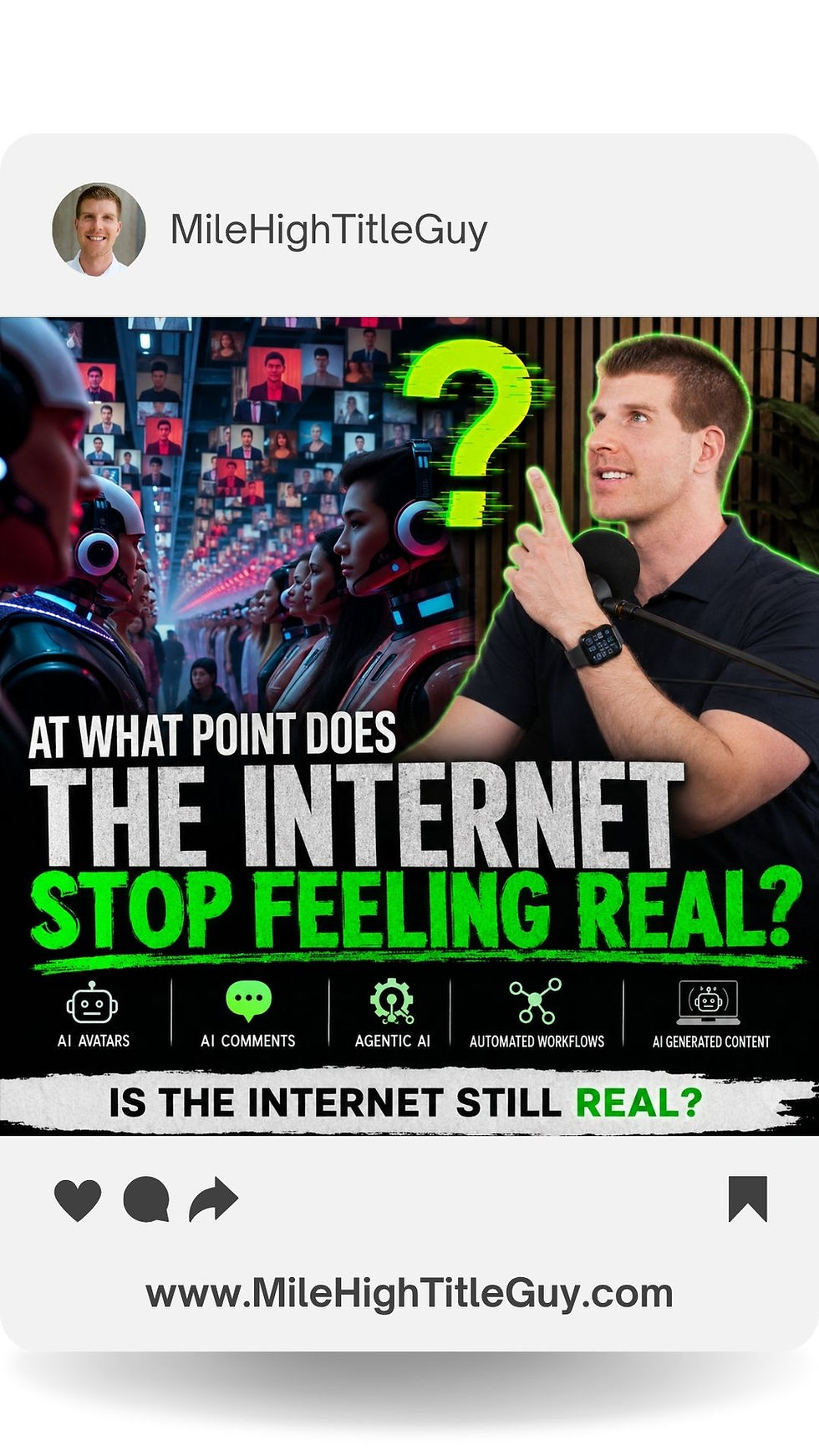
At what point does the internet stop feeling real?
That might sound dramatic, but I do not think it is that far off from what a lot of people are already feeling.
If someone comments on your post, did they actually write it?
If someone likes your video, was it really them?
If a blog post was created by AI, then another AI tool trains off of that blog post, then more AI content gets created from that content, how do we know what is real, what is original, and what is actually worth trusting?
This conversation is sometimes connected to what people call the “Dead Internet Theory,” which is the idea that more online content and engagement is being driven by bots, algorithms, AI-generated content, and non-human activity instead of authentic human interaction. A 2025 research survey described the theory as being tied to concerns about bots, AI-generated content, engagement metrics, and a decline in meaningful online interaction.
I am not saying every part of that theory is true.
But I do think the feeling behind it is worth paying attention to.
I’m Not Anti-AI
Let me be very clear.
I use AI. I teach AI. I talk about AI all the time. I believe AI can save real estate professionals a massive amount of time.
I think AI can help agents write better listing descriptions, create market reports, repurpose video content, organize data, build workflows, summarize documents, improve marketing, and show up more consistently online.
I do not think the answer is, “Do not use AI.”
That is not realistic.
The better question is:
How do we use AI without removing the human part of the business?
Because there is a big difference between using AI as a tool and flooding the internet with content that has no real human thought, perspective, experience, or accountability behind it.
That difference matters.
Especially in real estate.
Why This Matters So Much In Real Estate
Real estate is built on trust.
People are not just hiring you because you can open a door, write an offer, or post a listing online.
They are hiring you because they trust your judgment.
They trust your local knowledge.
They trust your communication.
They trust your ability to guide them through one of the biggest financial decisions they may ever make.
So if your online content starts to feel fake, generic, overly automated, or disconnected from who you actually are, that can become a problem.
People want to know there is a real person behind the post.
A real person behind the advice.
A real person behind the video.
A real person behind the comment.
A real person behind the relationship.
That is why this AI conversation is not just about technology. It is about trust.
And trust is still the most valuable currency in real estate.
The Trust Gap Is Already Showing Up
This is not just a random feeling. There is data behind the shift.
Pew Research Center’s 2026 research on Americans and AI found that public opinion around AI is still mixed, with people using AI tools while also expressing concerns about how AI may affect society.
Reuters Institute research on generative AI and news also found a trust gap between how people view traditional news sources and how they view AI-generated answers or AI tools. In other words, even when people are using AI, they are not automatically trusting everything AI produces.
That is important for anyone creating content.
Because if consumers become more skeptical of what they see online, then the real advantage will go to the people who feel more authentic, not less.
The agents who can show their face, share their real perspective, provide local context, and build actual relationships are going to stand out.
Not because they refuse to use technology.
But because they use technology without losing themselves in the process.
AI Content Is Not The Problem. Empty Content Is The Problem.
Here is where I think we need to be careful.
AI-generated content is not automatically bad.
A blog post written with AI can still be helpful.
A caption created with AI can still sound like you.
A video script drafted with AI can still communicate your real thoughts.
A market report created with AI can still help a seller understand what is happening in their neighborhood.
The issue is not that AI was involved.
The issue is whether there was real human judgment involved.
Did you review it?
Did you add your opinion?
Did you check the facts?
Did you make it specific to your market?
Did you make sure it sounds like you?
Did you remove anything generic, fluffy, misleading, or inaccurate?
That is the line.
AI should help you create faster, but it should not replace your responsibility to think.
The Rise Of AI Slop
We are already seeing a lot of low-quality AI content online.
People are calling it “AI slop,” and honestly, that phrase makes sense.
It is the endless stream of generic content that technically exists, but does not really say anything.
It might have a catchy hook.
It might have a stock-looking image.
It might have a perfectly structured caption.
But there is no real insight behind it.
No story.
No local expertise.
No personal experience.
No actual point of view.
That kind of content might create short-term volume, but I think it creates long-term distrust.
And as more people see it, they start to tune out.
That is where real estate agents need to be careful.
You do not want your marketing to feel like it could have been posted by anyone in any market.
You want your audience to feel like it came from you.
Platforms Are Trying To Respond
The major platforms are already trying to figure this out.
Meta announced that it would begin labeling certain AI-generated content across Facebook, Instagram, and Threads.
YouTube also requires creators to disclose realistic AI-generated or altered content in certain situations, especially when the content could make viewers think something happened that did not actually happen.
The FTC has also taken action around fake reviews and testimonials, including concerns about AI-generated fake reviews and fake indicators of social media influence.
That tells me something.
This is not just a creator issue.
This is not just a marketer issue.
This is becoming a trust issue across the entire digital world.
And if the platforms, regulators, creators, and consumers are all trying to figure out what is real, real estate professionals should be thinking about it too.
Fake Engagement Is A Real Concern
One of the biggest issues I see coming is fake engagement.
Because with AI and automation, it is becoming easier to automate likes, comments, replies, follows, messages, and engagement patterns.
That sounds convenient.
But it also creates a weird problem.
If I post something and someone comments, “Great insight, Jerad,” was that actually them?
Did they read it?
Did they care?
Did an assistant write it?
Did an AI tool generate it?
Did a bot do it?
And once people start questioning that too often, engagement loses value.
That is a big deal because social media has been built around engagement.
Likes, comments, shares, saves, views, replies, DMs, watch time.
But if people start to believe that a lot of that engagement is artificial, they may become less emotionally invested in the platforms.
They may still scroll.
They may still consume.
But they may trust less.
And that is a huge distinction.
What This Means For Real Estate Agents
For real estate agents, I think this creates both a challenge and an opportunity.
The challenge is obvious.
It is going to become harder to stand out if everyone is using the same tools to create similar content.
If every agent has access to AI captions, AI blog posts, AI videos, AI market updates, AI newsletters, AI listing descriptions, and AI social media calendars, then the baseline level of content goes up.
But the opportunity is even bigger.
Because when everything starts to feel automated, human connection becomes more valuable.
Your face matters.
Your voice matters.
Your opinion matters.
Your local market knowledge matters.
Your relationships matter.
Your ability to tell a real story matters.
Your ability to say, “Here is what I am seeing in the Denver market right now,” matters.
That is what AI cannot fully replace.
It can help you organize your thoughts, but it cannot be you.
The Agents Who Win Will Use AI With A Point Of View
I do not think the winning strategy is to avoid AI.
I think the winning strategy is to use AI with a point of view.
That means you are not just asking AI to create generic content.
You are feeding it your real thoughts.
Your real stories.
Your real market data.
Your real seller conversations.
Your real buyer questions.
Your real listing experiences.
Your real lessons learned.
Your real community involvement.
Then AI helps you organize, polish, repurpose, and distribute that information.
That is a very different workflow than saying, “Write me 30 real estate captions.”
One creates content.
The other creates content that actually sounds like you.
A Better Way To Think About AI In Your Content
Here is how I would think about it.
Use AI to save time on the parts that slow you down.
Let it help you:
Turn a video transcript into a blog post
Break a long idea into social media captions
Create multiple headline options
Summarize MLS data into seller-friendly language
Build a rough outline for a newsletter
Create a draft of a market update
Repurpose one idea across multiple platforms
Organize your thoughts before recording a video
But do not let AI remove your perspective.
Before you post anything, ask yourself:
Would I actually say this?
Is this true?
Is this helpful?
Is this specific?
Does this sound like me?
Does this help my audience make a better decision?
Would a real client, agent, buyer, seller, or lender actually care about this?
Those questions matter.
Authenticity Is Going To Become A Competitive Advantage
The more AI-generated content shows up online, the more authenticity will stand out.
That does not mean your content has to be perfectly polished.
Honestly, sometimes overly polished content is part of the problem.
People want real.
They want useful.
They want practical.
They want to know who they are working with.
That is why video is still so powerful.
That is why stories still work.
That is why behind-the-scenes content works.
That is why local market commentary works.
That is why real examples work.
That is why your personal take on a topic works better than a generic summary.
Especially in real estate, people want to work with someone they feel like they know.
AI can help you show up more often, but your job is to make sure you are still showing up as yourself.
The Question Agents Should Be Asking
Instead of asking, “Should I use AI for content?”
I think the better question is:
“Will this content help people trust me more or less?”
That is the filter.
If AI helps you create something clearer, more useful, more educational, and more consistent, use it.
If AI helps you take real market knowledge and turn it into content your audience can understand, use it.
If AI helps you save time so you can spend more time building relationships, use it.
But if AI is helping you pump out generic content just for the sake of posting, be careful.
Because more content does not always mean better marketing.
Sometimes it just creates more noise.
What Consumers May Start Looking For
As more people become aware of AI-generated content, I think consumers may start looking for different trust signals.
They may pay more attention to:
Is this person showing their face?
Are they sharing real local knowledge?
Are they giving specific examples?
Are they willing to explain their reasoning?
Are they consistent online and offline?
Do they have real relationships in the community?
Are they transparent about how they use tools?
Does their content feel helpful or just automated?
That does not mean every post has to be deeply personal.
But it does mean that your content needs to feel connected to a real person.
Because in a world full of automated content, the real human behind the brand becomes the differentiator.
My Take On Where This Is Headed
I do think some people will become more disengaged from certain parts of the internet.
I think some people are already exhausted by the amount of content they see.
I think some people are tired of not knowing what is real.
I think some people are becoming more skeptical of viral posts, comments, reviews, videos, articles, and even search results.
But I also think people will adapt.
They will get better at spotting what feels fake.
They will rely more on trusted sources.
They will follow people who consistently provide value.
They will pay more attention to local experts.
They will reward creators who are transparent, thoughtful, and real.
For real estate professionals, that is the opportunity.
You do not need to become the loudest person online.
You need to become one of the most trusted.
How I Would Use AI Without Losing Trust
If I were an agent thinking through this, here is the approach I would take.
First, I would absolutely use AI.
I would use it to save time, organize ideas, analyze data, improve content, and repurpose my work.
Second, I would create more content from real experiences.
Client questions.
Seller objections.
Market shifts.
Listing stories.
Inspection issues.
Neighborhood observations.
Buyer conversations.
Pricing conversations.
Open house takeaways.
Things that actually happen in your business.
Third, I would add my own voice before publishing anything.
Not just a quick proofread.
I mean actual perspective.
What do I think?
What would I tell a client?
What does this mean in my market?
What is the practical takeaway?
Fourth, I would be thoughtful about automation.
Just because something can be automated does not mean it should be.
There is a difference between automating a workflow and automating a relationship.
That difference matters.
The Real Estate Relationship Still Matters
At the end of the day, real estate is still a relationship business.
AI can help with marketing.
AI can help with data.
AI can help with content.
AI can help with speed.
AI can help with efficiency.
But AI is not going to replace the trust someone feels when they know you are paying attention, communicating clearly, and giving them honest guidance.
That is the part we cannot lose.
The more automated the internet becomes, the more valuable real relationships become.
And that might actually be the best opportunity for agents who are willing to show up with substance.
Final Takeaway
I do not think AI is ruining the internet by itself.
But I do think low-effort, fake, automated, and overly generic content can make people trust the internet less.
The agents who win moving forward will not be the ones who ignore AI.
They will be the ones who use AI thoughtfully.
Use it to save time.
Use it to become more consistent.
Use it to explain complex topics more clearly.
Use it to turn your real expertise into better content.
But do not use it as a replacement for your voice, your judgment, your relationships, or your responsibility to tell the truth.
Because especially in real estate, trust is everything.
And in a world where more content starts to feel fake, being real might become your biggest advantage.
Want more real estate tools, resources, and marketing ideas? Subscribe at MileHighTitleGuy.com/subscribe for exclusive access and event invites.


Comments